The index if
refraction is defined as a ratio of the average speed of light through a medium
divided by the speed of light through a vacuum.
“n” is the
index of refraction, “v” is the average speed of light through a medium, and vc is the speed of light through a vacuum. The speed of light is 3.00x 10⁸ m/s in a vacuum.
All angles in optics
are measured with respect to the line normal to the surface.
Because of the duality nature of light, it
can be said that it travels in rays or waves. For this unit we are looking at
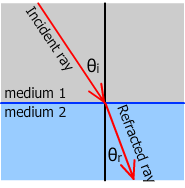
the ray properties of light. The ray of light that hits a surface is called the
“incident” ray. The angle the incident ray makes
between the normal line and the ray called the incident angle. The Ray that bounces off a surface is
called the “reflected” ray. The ray that travels to the other side
of the surface is called the “refracted”
ray. "To refract" means "to bend." The line separating the two mediums is called the “boundary.” “Medium” is another name for the material
light travels through.
Snell’s Law
mathematically states:
Where is on one side of
the boundary and is for value on
the other side on the boundary
Refraction of Light in Glass
Purpose: To use Snell's Law to
determine the index of refraction (n) of a piece of glass and to use it to find
the speed of light in that glass.
Place your glass in the middle of a piece of paper and
sketch its outline with a pencil. Some glass pieces have chipped edges and may
cut you. Be careful !
2.
Use a sharp pencil to draw an outline of the glass.
3.
Remove the glass from the paper.
4.
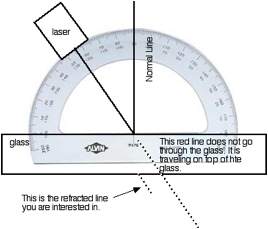
Use the protractor to draw line that is normal to the long
edge of the rectangle. This line should be near the middle of the long side of
the rectangle.
5.
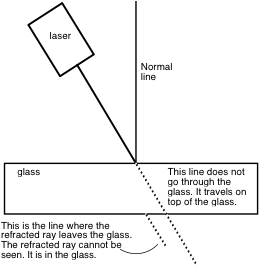
Turn the Laser level on. Place it on the paper such that
the red line it projects is aimed at the intersection between the normal line you
drew and the edge of the rectangle.
6.
Place the glass on the rectangle. Carefully line it up so
that is it is perpendicular to the normal line.
7.
Make a dot where the laser’s light first hits the paper as
it comes from the line level.
8.
You should see two red lines on the side of the glass
opposite the laser level. One line is projected above the glass. The second
line is shorter and not as bright. Only the second line went through the glass.
This is the refracted light ray and it the one you are interested in. Use the
protractor to draw a DOTTED line along this refracted red line.
9.
Remove the glass from the paper. Draw a spline consisting
of two lines. The first is the incident ray, the second is the refracted ray
as it travels through the glass. Draw the refracted ray about 0.12 cm or longer.
10.
Extend the refracted ray about 0.12 m.
11.
Measure the angle between the incident line and normal
line.
12.
Measure the angle between the refracted line and the
normal line.
13.
Repeat this procedure for 5 different angles between 15 and 70 degrees.FIll out the data table on the handout shown below in the "Data and Questions" section.
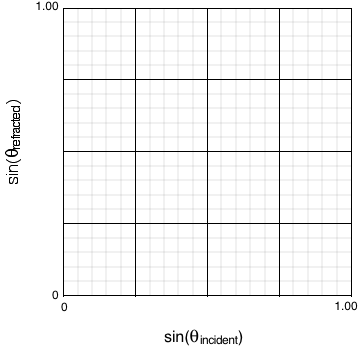
DRAW A GRAPH of the sin(θincident) vs sin(θrefracted) on the grid below.
The slope is the ratio of . The index of for the incident ray is air, n=1.00.
Use
the graph to determine the index of the glass the light travels through and the
average speed of the light through this glass. Show your work.
by Tony Wayne ...(If you are a teacher, please feel free to use these resources in your teaching.)
The owner of this website does not collect cookies when the site is visited. However, this site uses and or embeds Adobe, Apple, GoDaddy, Google, and YouTube products. These companies collect cookies when their producs are used on my pages. Click here to go to them to find out more about how they use their cookies. If you do not agree with any of their policies then leave this site now.


 Because of the duality nature of light, it
can be said that it travels in rays or waves. For this unit we are looking at
the ray properties of light. The ray of light that hits a surface is called the
“
Because of the duality nature of light, it
can be said that it travels in rays or waves. For this unit we are looking at
the ray properties of light. The ray of light that hits a surface is called the
“